1. Front page
  2. What does a conservator do?

What does a conservator do?

Objects found during archaeological excavations are often very fragile and deteriorated. They may have been buried underground for thousands of years, and when exposed to air and light, the deterioration can worsen. The same applies, for example, to a wooden sculpture that has stood in the basement beneath an old church. To preserve and prevent further damage to such objects, they are conserved.

An object that is to be conserved is first examined very carefully. The conservator needs to know exactly what kinds of damage the object has and what has caused them. This may include fragility, cracks, or discolouration that have developed as a result of how the object has been stored or handled. After the examination, the conservator determines which measures are needed to preserve the object. Cleaning is usually the first step, sometimes carried out under a microscope. It may also be necessary to reattach loose parts, secure flaking paint, or make various reinforcements.
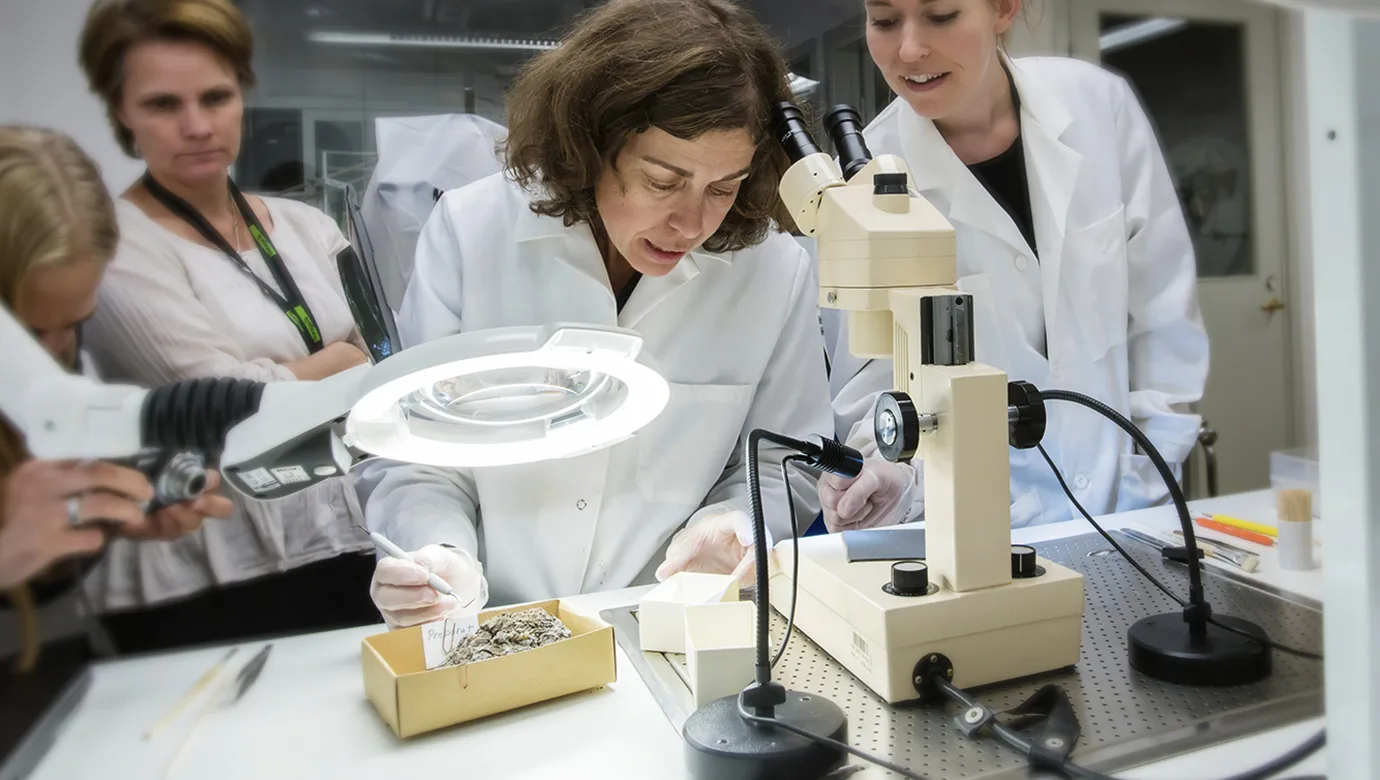
Person at microscope
Conservator at work. Photo: Katarina Nimmervoll, The Swedish History Museum/SHM (CC BY 4.0)

Delicate hands

All conservation work is carried out with great care, and the aim is to make as few interventions as possible. The conservator also decides how the object should be stored to ensure its long-term preservation – an object intended for display in a museum may, for example, require a special case with the right temperature and light levels.

As different materials deteriorate in different ways, conservators often specialise in a particular material, such as wood, textiles, or metal. The profession requires knowledge of chemistry and technology, as well as of art and craft history and archaeology. The word conservation comes from the Latin conservare, meaning to preserve.
Summary

A conservator examines, cleans, and preserves objects to prevent further damage and maintain their condition. The conservator also determines how the object should best be stored, for example with the right temperature and lighting. Since different materials deteriorate in different ways, conservators often specialize in a specific material, such as wood, textiles, or metal. The profession combines knowledge of chemistry, technology, art and craft history, and archaeology.

You may also be interested in

How we work with knowledge at the Swedish History Museum

The Swedish History Museum is part of the government agency National Historical Museums. The agency employs experts in various fields, such as history, archaeology, conservation, and more. The texts on the website are produced in collaboration between different experts, educators, and other staff. The texts have been fact-checked and are based on established research. In some cases, written sources are lacking and the physical remains are limited and ambiguous, especially far back in time. In such cases, the material is interpreted by the experts. However, the interpretations are always based on research.

Text summaries and translations have been created with the help of AI and have been fact-checked.

If you have questions about the factual background of our texts, please contact webb@historiska.se.

History hub

Search for articles and objects in the History hub. Sort and filter by time period and theme to find what's relevant to your specific interests.