List of Swedish Monarchs
By the late 12th century, Sweden consisted of Svealand, Götaland, and the southern parts of the Norrland coast. The kingdom was divided into provinces, each with its own laws. The areas we now know as Skåne, Halland, and Blekinge belonged to Denmark, while Härjedalen and Jämtland were part of Norway.
At this time, two powerful dynasties were vying for the throne: the House of Sverker from Östergötland and the House of Erik from Västergötland. In 1250, King Eric XI, known as “Eric the Lisp and Lame,” died, bringing the House of Erik to an end. Under the next three rulers—Birger Jarl, Valdemar, and Magnus Ladulås—significant changes took place, strengthening royal power. Tax collection became more efficient, and the laws of each province began to be recorded in writing. However, there were still no laws that applied to the entire realm.
The political heart of the country was now the Mälaren Valley. Stockholm was founded in 1252 and quickly became the largest city in the kingdom. During the 12th and 13th centuries, Finland was conquered and Christianised through three crusades. It remained part of Sweden until 1809, when it was annexed by Russia.
Magnus Eriksson
Magnus Eriksson became king of both Sweden and Norway at the age of just three. His reign saw the introduction of important laws and the abolition of slavery, both of which had a lasting impact on Swedish history.
No Swedish king has ruled over a larger realm than Magnus Eriksson. His dominion stretched from Karelia in the east to Greenland in the west, and from the Arctic Ocean in the north to the Öresund strait in the south. He inherited Norway and Iceland. Because he was only three when he ascended the throne, a regency governed in his stead until he came of age. Even so, his early reign was a success, marked by reforms that improved the lives of the peasantry.
In 1335, King Magnus outlawed slavery—it was no longer permitted to keep people as slaves. In 1350, the old provincial laws were replaced by a single law that applied throughout the kingdom: Magnus Eriksson’s National Law. A separate legal code for towns was also introduced at the same time.
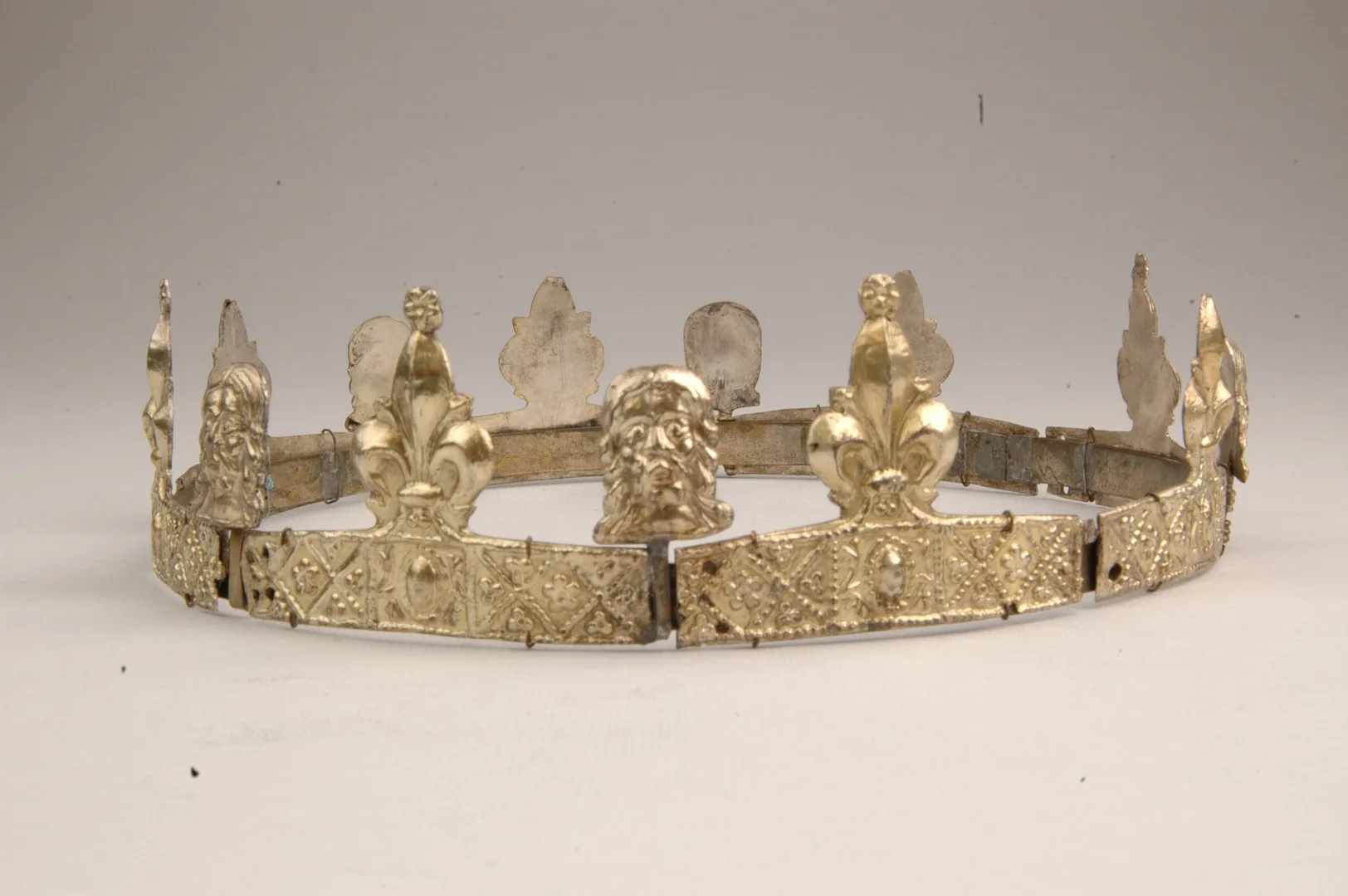
Silverkrona
Från Åseda socken i Småland
King Albert (Albrekt) had the backing of the North German cities of the Hanseatic League, a powerful trading alliance. When he came to Sweden, he awarded high offices and considerable influence to German nobles and merchants. Many royal castles were placed under the control of German lords, and Swedish towns came to be dominated by the Hanseatic League, which now held sway over the Baltic Sea. Meanwhile, Albert continued his war against the deposed Magnus Eriksson and his supporters in Norway. The wars placed a heavy burden on the royal treasury, and taxes were raised to cover the costs, hitting the population hard.
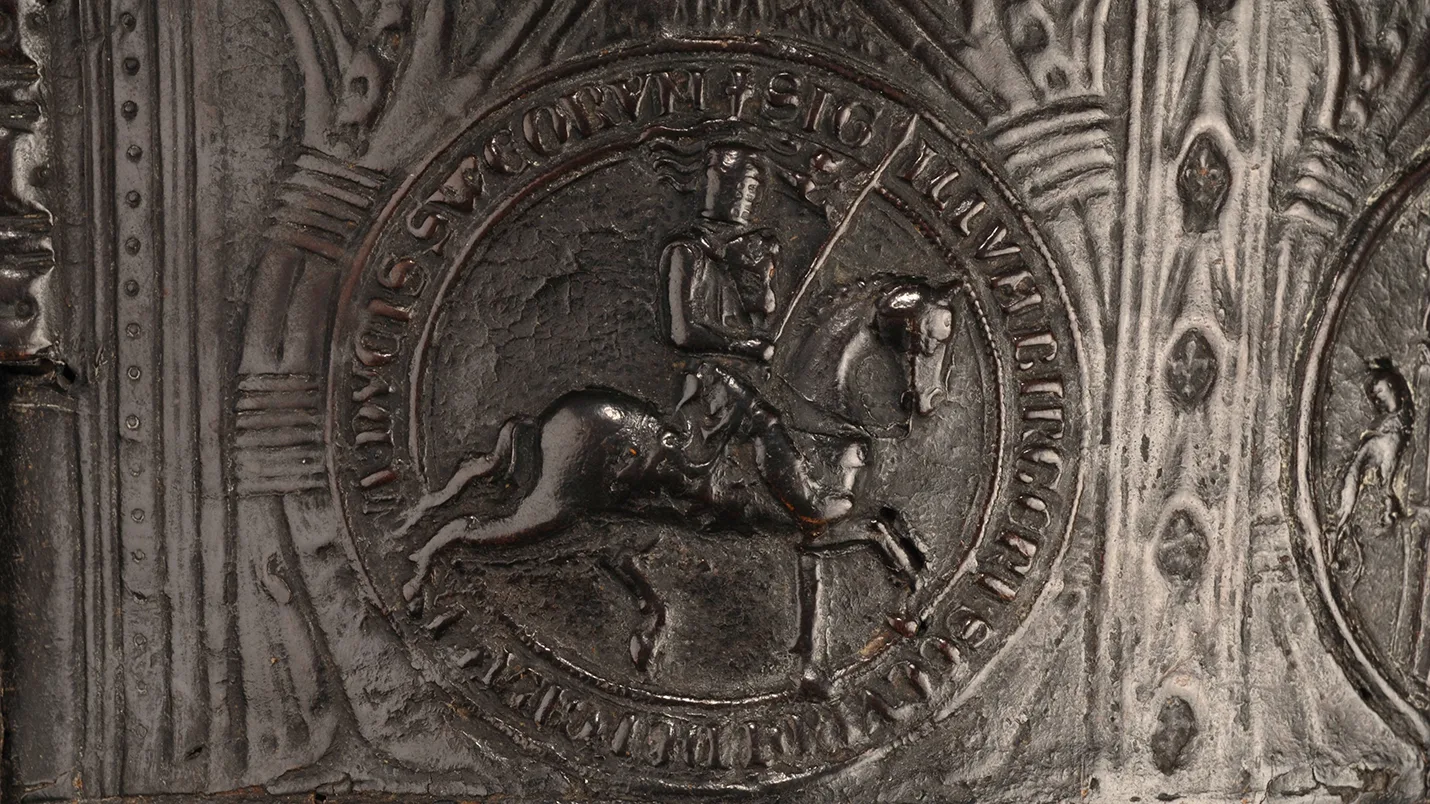
A Time of Turmoil
Then came the plague—the Black Death—and many perished. As a result, state revenues declined. Disagreements arose between King Magnus Eriksson and the nobles over how to manage the kingdom’s finances. This marked the beginning of a prolonged power struggle between the monarchy and the aristocracy in Sweden.
The nobles rebelled, and Magnus was deposed and later reinstated several times. This instability weakened the kingdom, and in 1360, the Danish king Valdemar Atterdag reclaimed Skåne, Halland, and Blekinge. The following year, the Danes also invaded and plundered Öland and Gotland.
In 1363, the Swedish-Norwegian and Danish royal houses were united through the marriage of Magnus’s son, Håkon, to Valdemar Atterdag’s daughter, Margaret. The Swedish nobles initially opposed the union and instead supported Magnus Eriksson’s nephew, the German prince Albert of Mecklenburg, as king.
The Museum’s Line of Swedish Monarchs
The monarchs we know the most about are those who have been widely chronicled in written sources. The tradition of numbering kings—Oscar I, Oscar II, and so on—was introduced by Gustav Vasa’s son, Eric XIV. He chose his regnal number by including many semi-legendary royal predecessors who are now largely considered figures of myth.
The Munsö Line
Erik Segersäll 970–995 (d. 995)
Olof Skötkonung 995–1022 (d. 1022)
Anund Jakob 1022–1050 (d. 1050)
Emund den gamle 1050–1060 (d. 1060)
The Stenkil Line
Stenkil 1060–1066 (d. 1066)
Tronstrider 1066–1067
Halsten 1067–1070 och ev. 1079–1081 (d. senast 1081)
Mycket osäker period 1070–1079
Anund Gårdske 1070–1075
Håkan Röde 1070–1079 (d. tidigast 1079, senast 1100)
Inge d.ä. (ev. ej erkänd i Svealand i början av 1080-talet) 1079–1105 (d. 1105)
Blot-Sven (ev. en sagokung) 1080-talet (tre år) (d. ?)
Filip (kallas även Filippus) 1105–1118 (d.1118)
Inge d.y. 1110–1125 (d. senast 1125)
Ragnvald Knaphövde (ej erkänd i hela riket) 1120-talet (d. 1120-talet)
Magnus den Starke (vald av västgötarna men ej erkänd som kung) 1120-talet
(d. 1134)
The Sverker (S) and Erik Line (E), and more
Sverker d.ä. (S) 1130–1156 (d. 1156)
Erik den helige (E) 1150–1160 (d. 1160)
Magnus Henriksson (ej erkänd som kung i hela riket) 1160–1161 (d. 1161)
Karl Sverkersson (S) 1161–1167 (d. 1167)
Kol och Burislev Sverkersson (S) (ej erkända i hela riket) 1167–1173 (d. senast 1169 resp. senast 1173)
Knut Eriksson (E) 1167–1196 (d. 1196)
Sverker d.y. Karlsson (S) 1196–1208 (d. 1210)
Erik Knutsson (E) 1208–1216 (d. 1216)
Johan Sverkersson (S) 1216–1222 (1201–1222)
Erik läspe och halte (E) 1222–1229 (1216–1250)
Knut Långe (Knut Holmgersson) 1229–1234 (d. 1234)
Erik läspe och halte (E) 1234–1250 (1216–1250)
The Folkunger Line (also called the Bjälbo Line)
Birger jarl (regerande riksjarl) 1248–1266 (1200–1266)
Valdemar Birgersson 1250–1275 (1240–1302)
Magnus Ladulås 1275–1290 (1240–1290)
Birger Magnusson 1290–1318 (1280–1321)
Mats Kettilmundsson 1318–1319 (rikshövitsman) (d. 1326)
Magnus Eriksson 1319–1364 (1316–1374)
Erik Magnusson (medregent till Magnus Eriksson) 1356–1359 (1339–1359)
Håkan Magnusson (medregent till Magnus Eriksson) 1362–1364 (1340–1380)
Albrekt av Mecklenburg 1363–1389 (1338–1412)
Unionsregenter erkända i Sverige, inhemska kungar samt riksföreståndare
Margareta 1389–1412 (1353–1412)
Erik av Pommern 1396–1435 och 1436–1439 (1382–1459)
Engelbrekt Engelbrektsson 1435–1436 (rikshövitsman) (d. 1436)
Karl Knutsson (Bonde) 1438–1440 (riksföreståndare) (1408/1409–1470)
Kristofer av Bayern 1440–1448 (1416–1448)
Bengt Jönsson (Oxenstierna) och Nils Jönsson (Oxenstierna) 1448 (riksföreståndare)(1390-talet–1449/1450) och (1390-talet–1450)
Karl Knutsson (Bonde) 1448–1457 (1408/1409–1470)
Jöns Bengtsson (Oxenstierna) och Erik Axelsson (Tott) 1457 (riksföreståndare) (1417 1467) och (1415–1481)
Kristian I 1457–1464 (1426–1481)
Kettil Karlsson (Vasa) 1464 (riksföreståndare) (1433–1465)
Karl Knutsson (Bonde) 1464–1465 (1408/1409–1470)
Kettil Karlsson (Vasa) 1465 (riksföreståndare) (1433–1465)
Jöns Bengtsson (Oxenstierna) 1465–1466 (riksföreståndare) (1417–1467)
Erik Axelsson (Tott) 1466–1467 (riksföreståndare) (1415–1481)
Karl Knutsson (Bonde) 1467–1470 (1408/1409–1470)
Sten Sture d.ä. 1470–1497 (riksföreståndare) (1440–1503)
Hans (Johan II) 1497–1501 (1455–1513)
Sten Sture d.ä. 1501–1503 (riksföreståndare) (1440–1503)
Svante Nilsson (Sture) 1504–1511 (riksföreståndare) (1460–1511)
Erik Trolle 1512 (riksföreståndare) (1460–1529/1530)
Sten Sture d.y. 1512–1520 (riksföreståndare) (1492/1493–1520)
Kristian II 1520–1523 (1481–1559)
Gustav Vasa 1521–1523 (riksföreståndare) (1496–1560)
Vasaätten
Gustav I Vasa 1523–1560 (1496–1560)
Erik XIV 1560–1568 (1533–1577)
Johan III 1568–1592 (1537–1592)
Sigismund 1592–1599 (1566–1632)
Hertig Karl (IX) 1599–1604 (riksföreståndare) (1550–1611)
Karl IX 1604–1611 (1550–1611)
Gustav II Adolf 1611–1632 (1594–1632)
Kristina 1632–1654 (förmyndarregering 1632–1644) (1626–1689)
Pfalziska ätten
Karl X Gustav 1654–1660 (1622–1660)
Karl XI 1660–1697 (förmyndarregering 1660–1672) (1655–1697)
Karl XII 1697–1718 (förmyndarregering 1697) (1682–1718)
Ulrika Eleonora 1719–1720 (1688–1741)
Hessiska ätten
Fredrik I 1720–1751 (1676–1751)
Holstein-Gottorpska ätten
Adolf Fredrik 1751–1771 (1710–1771)
Gustav III 1771–1792 (1746–1792)
Gustav IV Adolf 1792–1809 (förmyndarregering 1792–1796) (1778–1837)
Hertig Karl (XIII) 1809 (riksföreståndare) (1748–1818)
Karl XIII 1809–1818 (1748–1818)
Bernadotteska ätten
Karl XIV Johan 1818–1844 (1763–1844)
Oscar I 1844–1859 (1799–1859)
Karl XV 1859–1872 (regent 1857–1859) (1826–1872)
Oscar II 1872–1907 (1829–1907)
Gustaf V 1907–1950 (1858–1950)
Gustaf VI Adolf 1950–1973 (1882–1973)
Carl XVI Gustaf 1973– (1946– )